_edited_edited.png)
How to buy property in Dubai from the US: A step-by-step guide for US based investors
The Case for Dubai in 2026
Buying property in Dubai from the US is far more straightforward than most investors expect and the financial case has never been stronger.
Dubai charges zero tax on rental income and zero capital gains tax on residential property. For a US investor used to losing a portion of rental income to federal and state taxes, the same gross rent in Dubai can translate into meaningfully stronger net returns.
The numbers support it. Gross rental yields across key Dubai investment areas continue to outperform many established US residential markets, while entry prices remain globally competitive.
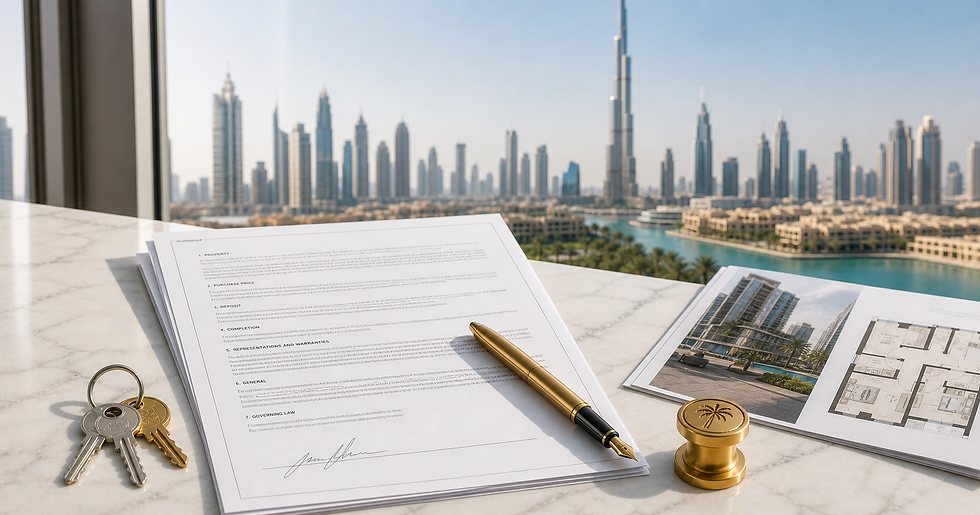
Just as important, the buying process is transparent. Mandatory escrow protection, verified construction progress, and digital access to ownership records mean a buyer sitting in New York, Dallas, or California can evaluate and transact with real visibility — without being on the ground.
That combination of yield, tax efficiency, and investor protection is why Dubai is attracting increasing US interest in 2026.
1. First, understand how ownership works in Dubai
If you own property in the US, you are used to Fee Simple — you own the structure and the land outright, forever. Dubai has two ownership categories for foreign buyers, and the distinction matters.
Freehold — what you want : Freehold is the Dubai equivalent of US Fee Simple. You own the unit and the land it sits on, in perpetuity. Your name goes on a title deed registered with the Dubai Land Department (DLD). Freehold areas include Downtown Dubai, Dubai Hills Estate, Dubai Creek Harbour, Palm Jumeirah, Business Bay, and JVC — most areas where off-plan projects are actively marketed to international investors. Freehold properties qualify for the Golden Visa.
Leasehold — avoid unless you know exactly what you are doing : Leasehold gives you an occupational right for a fixed term — typically 99 years. You do not own the land. Most international investors targeting capital appreciation or Golden Visa eligibility focus exclusively on freehold.
If a project is being marketed to US investors by a major developer — Emaar, DAMAC, Sobha, Nakheel, Binghatti — it is almost certainly freehold. Verify via the Dubai REST app (dubairest.ae) before you sign anything.
2. Two ways to buy: off-plan vs. ready property
Dubai's property market offers two distinct buying routes — off-plan and ready. They serve different investment objectives, follow different processes, and carry different cost structures. Neither is better than the other. The right choice depends on what you are optimising for.
Off-plan | Ready property | |
What you are buying | A unit under construction, from a developer | A completed unit, from a developer or seller |
Entry price | Lower — you are buying early | Higher — the asset exists and is priced accordingly |
Rental income | Starts at handover | Starts immediately |
Payment structure | Staged instalments over construction period | Full payment at transfer |
Capital appreciation | Higher potential — you buy before market repricing | More predictable — current market value |
Timeline | 2–5 years to handover depending on project | Immediate ownership |
Best for | Investors focused on appreciation and lower entry | Investors focused on immediate yield and certainty |
3. The off-plan buying journey
Off-plan property in Dubai is purchased directly from the developer — no seller, no agent commission, no NOC process. The journey is more structured and more straightforward than most US investors expect.
Step 1: Engage a RERA-registered advisor
Every broker operating in Dubai must hold a RERA licence, verifiable via the Dubai REST app (dubairest.ae). For US investors buying remotely, a registered advisor is not optional — they are the on-ground presence that shortlists projects, negotiates with developers, and manages the transaction on your behalf.
Worthmont's advisory team is RERA-registered and works exclusively with US-resident clients. Every recommendation is framed around IRS compliance, USD return modelling, and remote management practicality from the outset. For a breakdown of the five major developers and their current projects, see our Dubai Developers Ranked guide.
Step 2: Define your area and developer
Before looking at specific units, get clear on two things:
Area — which community fits your investment objective? Yield-focused investors look at JVC, DSO, Al Furjan. Appreciation-focused investors look at Dubai Creek Harbour, Dubai Hills Estate, Meydan. Lifestyle investors look at Downtown, Dubai Marina, Palm Jumeirah.
Developer — delivery track record, build quality, and financial standing vary significantly. Emaar offers the strongest delivery reliability. Sobha has the highest on-time completion rate. DAMAC and Binghatti require project-level due diligence.
Step 3: Shortlist and select the unit
Your advisor presents a shortlist of units across vetted projects matching your parameters. For each project, verify:
RERA registration via Dubai REST app (dubairest.ae)
Escrow account registered with the DLD
Construction progress on the DLD Project Tracker
Step 4: Pay the Expression of Interest (EOI)
Once you have selected a unit, you submit an Expression of Interest — typically AED 20,000–50,000 — to hold the unit while paperwork is prepared. This is generally refundable if you do not proceed. The developer issues a booking confirmation once received.
Step 5: Sign the booking form
Within a few days of the EOI, the developer issues a booking form confirming the unit, price, and payment plan. You sign and return this — digitally or via courier. This locks the unit to your name.
Step 6: Complete the first installment
Following the booking form, you typically have 30 days to complete the first installment — usually 20–24% of the purchase price, inclusive of the EOI already paid. This triggers the next step.
Step 7: Receive and sign the Sales and Purchase Agreement (SPA)
Once the first installment is cleared, the developer issues the Sales and Purchase Agreement (SPA). This is the primary legal document for off-plan purchases.
It sets out:
The full payment plan and installment schedule
The Anticipated Completion Date
The grace period (typically 6–12 months beyond the ACD)
The penalty clause mechanism (typically 1% per month on purchase price for delays beyond grace period)
The Force Majeure definition
Read the SPA carefully before signing. Your Worthmont advisor will walk you through the key clauses. The SPA can be signed digitally or via courier — no in-person attendance required.
Step 8: Receive the Oqood certificate
Once the SPA is signed and registered with the DLD, you receive an Oqood certificate — the official DLD registration document for off-plan ownership. The Oqood is your proof of ownership while the property is under construction.
It is the document used for:
UAE Golden Visa applications (if purchase value meets AED 2M threshold)
UAE bank account opening
Any future resale of the unit in the secondary market before handover
Step 9: Follow the payment plan through to handover
Subsequent installments follow the SPA payment schedule — typically linked to construction milestones verified by RERA-appointed auditors on the Mashrooi dashboard. Track construction progress quarterly. Your advisor monitors this on your behalf.
At handover, the developer issues a No Objection Certificate (NOC) confirming the unit is clean, and the DLD converts your Oqood into a full title deed.
4. The ready property buying journey
Ready property is purchased from a seller — either the original developer or a secondary market owner. The process involves more parties, more verification steps, and a slightly different cost structure, but delivers immediate ownership and immediate rental income.
Step 1: Shortlist the community
Identify the area and community that fits your investment objective. For yield, mid-market communities — JVC, DSO, Al Furjan, Business Bay — outperform the premium areas. For capital preservation and lifestyle, Downtown Dubai, Dubai Marina, and Palm Jumeirah remain the benchmarks.
Not sure where to start? Worthmont works exclusively with US-based investors and can map your objectives to the right community and product type.
Step 2: Identify and evaluate available units
Your advisor pulls available listings across the shortlisted community, filtering by price, floor, view, service charge rate, and building quality.
For each unit under serious consideration:
Request the service charge history — this directly affects net yield
Confirm whether the building is chiller-free (independent AC) or district-cooled — district cooling adds AED 4,500–15,000 per year in tenant costs, which affects vacancy and rent levels
Check the building's RERA registration and any outstanding violations via the Dubai REST app
Step 3: Agree the price and sign the MOU (Form F)
Once a unit is selected and price agreed, your advisor prepares Form F — the Memorandum of Understanding, the official DLD purchase contract for ready properties.
It covers:
Purchase price and deposit amount (typically 10%)
Timeline for NOC and transfer
Conditions under which either party can exit
Form F is signed by buyer and seller — digitally or in person. If you are in the US, your Power of Attorney holder signs on your behalf. See Section 5 on the POA process.
Step 4: Obtain the No Objection Certificate (NOC)
The seller requests an NOC from the developer confirming the unit is clean — no unpaid service charges, no mortgage encumbrances, no outstanding disputes. This is a mandatory step before the DLD transfer can proceed. NOC fees range from AED 500–5,000 depending on the developer and are typically paid by the seller.
Allow 5–10 business days for the NOC. Your advisor coordinates this.
Step 5: Transfer at the DLD Trustee Centre
The final step is the official ownership transfer at a DLD-approved Trustee Centre. Buyer, seller (or their representatives), and the advisor attend. The title deed is issued in your name within minutes of the transfer being processed.
If you are in the US, your POA holder attends on your behalf. The digital title deed is issued immediately and can be sent by email or couriered internationally.
5. Buying remotely: the power of attorney
Whether you are buying off-plan or ready, a Power of Attorney (POA) is what makes a fully remote Dubai purchase possible. It authorises a named person — your legal representative or a Worthmont-affiliated partner,
to sign documents and complete the DLD transfer on your behalf.
The US-to-Dubai POA process:
Your Dubai-based lawyer drafts the POA to DLD-required wording
You sign the document before a US Notary Public
You get the document apostilled by the Secretary of State in your state, a one-step authentication process effective January 2022 when the UAE joined the Hague Apostille Convention, replacing the old UAE Embassy attestation route
The original apostilled document is couriered to your representative in Dubai
Your representative gets it attested at the UAE Ministry of Foreign Affairs (MOFA) in Dubai
Allow 2–3 weeks for the full process. Start it early, do not leave it until the week of your transfer or signing date.
6. The USD to AED advantage
The UAE dirham has been pegged to the US dollar at AED 3.6725 since 1997. There is no currency risk between your USD and the AED purchase price. Your investment is effectively dollar-denominated.
That said, international wire transfer fees are real. On a USD 500,000 transfer, the difference between a retail bank and a regulated FX transfer service can be USD 3,000–8,000. Use a specialist for any transfer above USD 100,000.
Source of funds: Developers and Dubai banks require documentation showing where your purchase funds came from. Have ready: 6–12 months of bank statements, recent tax returns, and any supporting documentation — salary records, business income, or asset sale proceeds. This is standard AML compliance and applies to all buyers regardless of nationality.
7. Your IRS obligations: what you need to report
Dubai's zero-tax environment applies to the UAE side only. The IRS taxes worldwide income — and your Dubai rental income is no exception. Here is what applies:
Obligation | Trigger | Deadline | Form |
Rental income reporting | Any rental income received | Annual tax return | Schedule E (Form 1040) |
FBAR | UAE bank account balance exceeds USD 10,000 at any point in the year | April 15 (auto-extension to Oct 15) | FinCEN Form 114 (fincen.gov) |
FATCA | Foreign financial assets exceed USD 50,000 (single) / USD 100,000 (joint) at year end | With annual tax return | Form 8938 |
Capital gains on sale | Property sold at a profit | Annual tax return | Schedule D (Form 1040) |
A few important nuances:
On Schedule E, you can deduct property management fees, depreciation, and mortgage interest. Travel to Dubai for property management purposes may be partially deductible — confirm with your CPA.
Foreign real estate held directly in your own name does not count toward the FATCA threshold. Held through a foreign entity, it does.
Long-term capital gains rates apply if held for more than one year — 0%, 15%, or 20% depending on your income bracket. High earners (above USD 200,000 single / USD 250,000 joint) should also factor in the 3.8% Net Investment Income Tax (NIIT) on the gain.
Non-filing FBAR penalties start at USD 10,000 per violation for non-wilful failure. File on time.
Work with a CPA experienced in international real estate before you buy, not after. For a deeper dive into how US tax rules apply to Dubai property income, see our US tax and Dubai real estate guide.
8. Financing: can US buyers get a Dubai mortgage?
Yes — though most US buyers end up not using one.
Several UAE banks run dedicated non-resident mortgage programmes. The headline terms in 2026:
Term | Details |
Maximum LTV | 50% — minimum 50% down payment required |
Loan tenor | Up to 25 years |
Minimum income | Approx. AED 15,000/month (USD 4,085) |
Product types | Conventional and Sharia-compliant (Islamic) structures available |
Lenders with active non-resident programmes include Emirates NBD, Mashreq, Abu Dhabi Islamic Bank, and Dubai Islamic Bank. Terms vary by lender and borrower profile — engage a UAE mortgage broker for current rates.
In practice, most US investors buying Dubai property do so with cash or by leveraging against existing US assets, given the 50% LTV cap and the overhead of a cross-border lending process. If financing is important to your model, factor the 50% equity requirement in from the start.
9. Cost summary: off-plan vs. ready
The cost of buying Dubai property differs meaningfully between off-plan and ready purchases. Here is what each route actually costs:
Off-plan costs:
Cost item | Amount | Notes |
DLD Transfer Fee | 4% of purchase price | Sometimes waived or reduced by developer — confirm at booking |
Oqood Registration Fee | AED 4,020 | DLD off-plan registration fee |
Admin / Map Fee | AED 250–290 | Standard DLD fee |
Agent Commission | None | Off-plan purchases are made directly from the developer |
Total acquisition cost | ~4% of purchase price | Significantly lower than ready |
Ready property costs:
Cost item | Amount | Payer |
DLD Transfer Fee | 4% of purchase price | Buyer |
Trustee / Registration Fee | AED 4,000 + 5% VAT | Buyer |
Title Deed Issuance | AED 580 | Buyer |
Admin / Map Fee | AED 250–290 | Buyer |
Agent Commission | 2% + 5% VAT | Buyer |
Developer NOC Fee | AED 500–5,000 | Seller |
Mortgage Registration Fee | 0.25% of loan + AED 290 | Buyer (if financing) |
Total acquisition cost | 6.5–8% of purchase price |
For both routes, if buying remotely via POA:
Cost item | Amount |
POA Notarisation + Apostille (US) | USD 200–500 |
UAE POA Attestation (MOFA) | AED 500–1,000 |
10. Residency: Golden Visa and Investor Visa
A Dubai property purchase can qualify you for UAE residency — giving you a UAE address, access to UAE banking, and the legal right to live in the country.
Two thresholds apply in 2026:
Visa | Minimum investment | Duration | Key conditions |
UAE Golden Visa | AED 2M (approx. USD 545,000) | 10 years, renewable | Effective February 2026 — only DLD-certified property valuation needs to meet AED 2M. Full payment is no longer required. Mortgage accepted with bank NOC. |
UAE Investor Visa | AED 750K (approx. USD 204,200) | 2 years, renewable | Available on mortgaged properties; paid portion must exceed AED 750K. |
For off-plan buyers: Your Oqood certificate — issued after SPA signing and DLD registration — is the document used to apply for the Golden Visa. The property does not need to be complete. The total contracted value must meet AED 2M.
For ready property buyers: The title deed issued at the DLD Trustee Centre is the qualifying document.
Neither visa requires you to actually live in the UAE — you can hold it and remain US-based. Holding a UAE residency visa does not change your IRS filing status or create a UAE tax residency obligation.
Important: The property must be retained for a minimum of two years after visa issuance. Early disposal can trigger visa cancellation.
As of April 2026, a unified GDRFA–DLD digital platform has reduced Golden Visa approval timelines to approximately five working days.
FAQ
Can I use my 401(k) to buy Dubai property?
Not directly — a standard 401(k) cannot hold foreign real estate. A Self-Directed IRA (SDIRA) can, but the structure is complex. The SDIRA LLC becomes the legal owner of the property, you cannot use the property personally, and IRS prohibited transaction rules are strict. Any misstep can result in the entire IRA being treated as distributed and taxed immediately. Work with a qualified SDIRA custodian and an internationally experienced CPA before committing to anything. This is not a DIY setup.
Do I need a UAE bank account?
Not for the purchase itself — funds can be wired directly to the developer's DLD-registered escrow account or the seller. However, if you plan to receive rental income, a UAE account makes collection and repatriation significantly simpler. Emirates NBD, Mashreq, and ADCB all offer non-resident accounts. Expect to provide your passport, proof of address, and source of funds documentation. Requirements have tightened in recent years — allow time for the process.
Is the process 100% remote?
Almost. The MOU or SPA signing, NOC, and DLD transfer can all be handled by your POA representative in Dubai. The one step requiring your physical presence is the POA notarisation before a US Notary Public — everything after that runs remotely. Most Worthmont clients complete their purchase without travelling to Dubai at any stage.
Ready to get started?
The mechanics of buying Dubai property from the US are more straightforward than most people expect. What takes judgment is the layer above — which route, which developer, which area, which project, and how the investment is structured to work with your US tax position.
Worthmont works exclusively with US-based investors on Dubai and Abu Dhabi real estate. Every recommendation is framed around IRS compliance, USD return modelling, and what actually works for remote investors.
Reach out at info@worthmont.com to discuss your parameters.
Sources: Dubai Land Department (dubailand.gov.ae); RERA (rera.gov.ae); IRS Schedule E Form 1040; IRS Form 8938; FinCEN FBAR (fincen.gov); UAE Golden Visa (u.ae); GuestReady rental yield data (February 2026); The Middle East Insider DLD yield analysis Q1 2026; Sands of Wealth rental yield guide (January 2026); Engel & Völkers DLD fee guide (2026); betterhomes.com closing costs guide (March 2026); EGSH mortgage guide (February 2026). All figures reflect Q1 2026 market conditions.


Comments